Steve Watkins and Anne Little
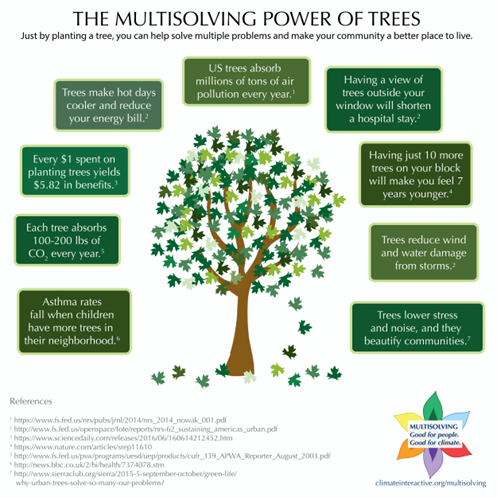
By 2030, Fredericksburg should have a fully developed Urban Forest Management Plan that sets out enhanced targets for tree canopy cover in the city—ideally 60 percent, which is the upper target range recommended for forested cities by the U.S. Forest Service. Achieving this enhanced tree canopy will have major climate benefits. First, trees have the ability to cool the city, areas without much tree cover and green space are measurably hotter than those that do. Second, tree canopies and roots can reduce water runoff after storms by catching and holding onto more moisture before it pours down our city streets into the Rappahannock River, which is important because flood events are expected to increase as the climate warms. Finally, trees themselves draw in carbon from the atmosphere and fix it in their branches, trunks, and roots. This means that preserving our forests and planting trees is an important climate solution in itself.
Fredericksburg’s enhanced 2030 urban forest management plan should identify areas and neighborhoods in the city that need to be prioritized for planting, so that the city has more even distribution of trees, the primary benefits including reduction of heat islands, especially in underserved areas, and increased mitigation of storm water runoff.
The city should have a full-time city arborist to monitor compliance with the Urban Forest Management Plan and coordinate with city staff and local environmental groups and state agencies.
Tree City USA reported that in 2006—more than 15 years ago—the average urban forestry expenditure per capita for a city the size of Fredericksburg that applied for certification as a Tree City was $9.57, which would be almost $14 per capita today. This should be the minimal annual funding in 2030 for Fredericksburg.
Basic goals of the Urban Forest Management Plan should include
- Preservation and protection of existing forested areas and trees
- Enhancement and restoration of forest quality (replacing invasive species with native plants)
- Expansion of planted areas and total number of trees
- Monitoring and documentation over time to track progress and needs
- Education and outreach to involve the entire community
- Sustainability and Maintenance of plan and related codes and guides
The city should also initiate and fund an ambitious incentive program to encourage more tree planting on private property. In addition, there should be a concerted effort to educate the residence about the importance of not removing mature trees on private property.
The city should also initiate and fund an ambitious incentive program to encourage more chemical-free nature-scaping as an eco-friendly alternative to grass lawns.
The city’s planting contracts with the nonprofit Tree Fredericksburg should include funding not only for the purchase and planting and care of trees, but also for at least two staff positions to assume the duties currently done on a volunteer basis by the two founders for the past fifteen years.
